

We're back, and there's plenty to get through. The news cycle isn't slowing down, so we've done the sifting and boiled it down to the bits that we find most interesting!
Update #4 - 29 September 2026
Who's liable when AI gets it wrong? A US court lets a defamation case against Google proceed.
Let's start with a crazy one! An author and TV producer in the US says Google's AI Overviews told searchers he was serving life in prison and had murdered three women. None of it is true. Shocking! His decades old drug conviction was expunged after he helped the FBI as a prison informant. A federal court in Illinois has now allowed his defamation claim against Google to proceed.
The court found an AI summary can reasonably be read as a statement of fact. He also says he told Google about the error repeatedly and similar claims kept appearing, which was enough for the case to continue. It's not a verdict, just a green light to keep going. It follows a Munich court ruling in June that held Google liable for false statements in AI Overviews.
Sources: Courthouse News Service, Search Engine Land.
Our take: for most businesses, the lesson is about housekeeping, not lawyers. AI will say things about your brand, and some of them might be wrong. As we've covered in previous editions, LLMs love citing third party sites, and what those sites say about you isn't always accurate. So check what AI Overviews, ChatGPT and Gemini say about you on a regular basis. When an answer is wrong and your own content isn't cited, report it, and get anyone else who sees it to do the same, and keep a record of what you flagged and when. Then optimise your own content to answer that question directly, in the first sentence of the page. You know the gist…
Search Console can finally see camera searches
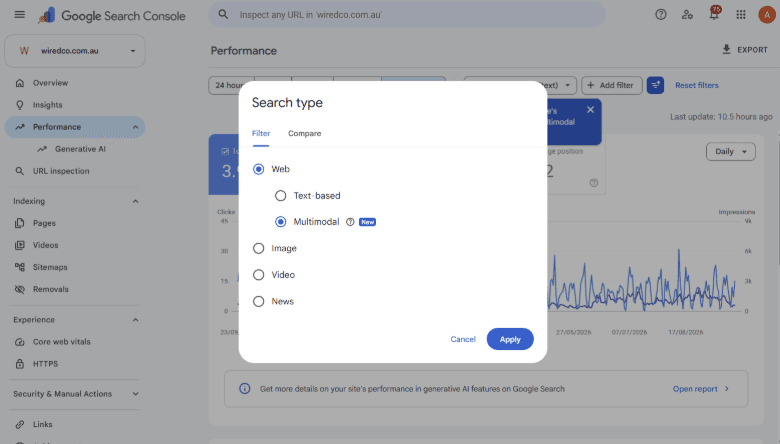
No surprise that people increasingly search by pointing a camera at something instead of typing, but until this week we couldn't report on this activity. Excitingly, on 24 September Google added a multimodal filter to Search Console's performance report. It splits the Web search type into text-based and multimodal, and covers Google Lens, Circle to Search on Android, images uploaded to Google Search, and Chrome's right-click "Search this image".
It's rolling out globally from now, and shows up in both the main performance report and the Generative AI features report. One limitation for now is that there’s no query data attached to the reports. We can see clicks, impressions and position only, which is better than nothing!
Sources: Google Search Central, Search Engine Roundtable.
Our take: this is one to take notice of if your products, venues or people are the kind of thing someone would photograph. Filter your performance report by multimodal, then compare it against text-based by page type. Pages that do well on text but get nothing visually is where there’s an opportunity to optimise. Original imagery that shows what you're selling, combined with clearer alt text will help those pages get found and earn visibility. Image optimisation is often left until last, and this is a good reason to give it proper attention.
Google lets online stores see what shoppers ask its AI
Since AI search took off, we still haven't been able to track it the way we track SEO, with keywords, search volume, intent and ranking pages. We can track prompts we choose to target, but not the query level view we get in SEO. That makes sense, since AI search queries are far more varied and long tail. Google Merchant Center (the free tool retailers use to send product listings to Google) now lets us into that world a little more. Its AI performance report is available to retailers in Australia, Canada, India, New Zealand and the US, for English-language questions and organic results only.
It has also evolved quite quickly. When it launched in July it was fairly basic. It now has three new sections:
Search intent: the kind of AI questions your products match.
Search terms: popular words shoppers use that are missing from your product descriptions.
Attributes: product details you haven't filled in that AI searches look for.
A new "Products showing" column tells you how many of your products appear for each.
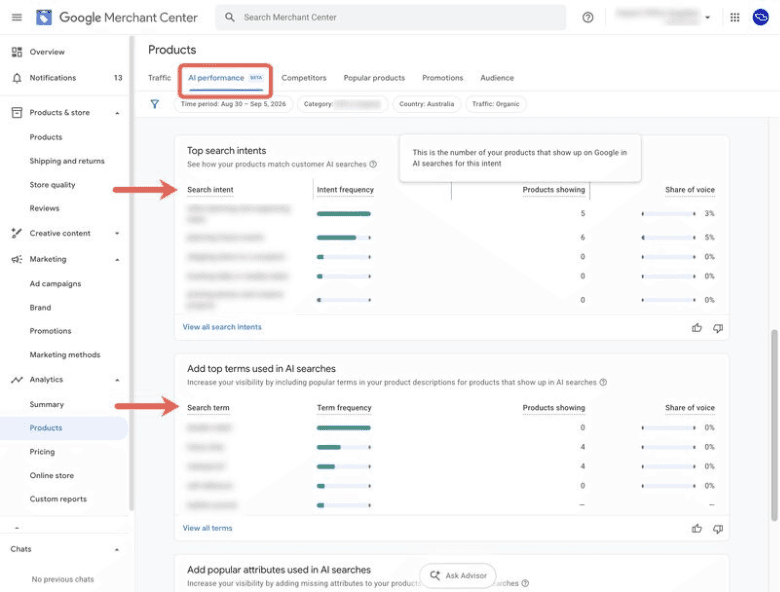
Merchant Center AI performance report, Australian account. Screenshot: Brodie Clark.
Sources: Google Merchant Center Help, Search Engine Roundtable.
Our take: if you sell online in Australia, Canada, India, New Zealand or the US, open Merchant Center and head to Analytics, then Products, then AI performance. It's the closest Google has come to showing what shoppers ask AI about your category, and these insights are GOLD. The biggest wins include adding the missing search terms and attributes to your product descriptions and feed, and filling in exactly the details the AI says it wants.
AI can now tell you what it thinks of you, not just whether it mentions you
Merchant Center shows which AI questions your products turn up in. This is the other half: what the answer actually says about you. Most AI visibility tracking stops at whether you were mentioned. The newer brand perception features in Peec AI and Profound go further. What is AI saying about your brand, and how does that compare with your competitors?
Peec AI runs thousands of prompts across ChatGPT, Gemini, AI Overviews and Perplexity, then groups the answers into themes. Positive attributes on one side, objections (or negative sentiment) on the other, each scored by how prominently it comes up and ranks against competitors in your category. Profound does the same through sentiment reporting, and can trace the tone back to the specific pages being cited.
We ran it on ourselves, in the Australian marketing and advertising category. AI sees WiredCo. as creative, innovative, data driven and strategic. Perfect!
Source: Peec AI brand perception, Australia, September 2026.
Our take: the positives are useful, for sure. The objections however are even more useful, and worth acting on. For example, if cost comes up as an objection in your category, the answer is pricing transparency, packaged options, proof that quality and value beat the cheapest option, published on pages an AI can read. If a competitor owns an attribute you care about, that's a gap you can write and pitch your way into. And where negative tone traces back to specific third party pages, that becomes a digital PR target list. Two caveats: this measures what AI says, not what customers believe, so treat it as a proxy. And what AI says about you moves as the sources move, which is the whole point. Change what's published about you and the perception follows.
The ads are learning to chat back
OpenAI is testing Sponsored Agents in ChatGPT. You click an ad, then start a labelled chat with the brand's own AI agent by tapping a "Chat with us" button like the one below. You can ask your follow-up questions there, and then head to the website when you're ready. OpenAI says that chat stays separate from ChatGPT's own independent answers, and is being tested in the US only, with a handful of advertisers. OpenAI has also rolled out Shopify and HubSpot integrations and AI-assisted ad creation in the same update.


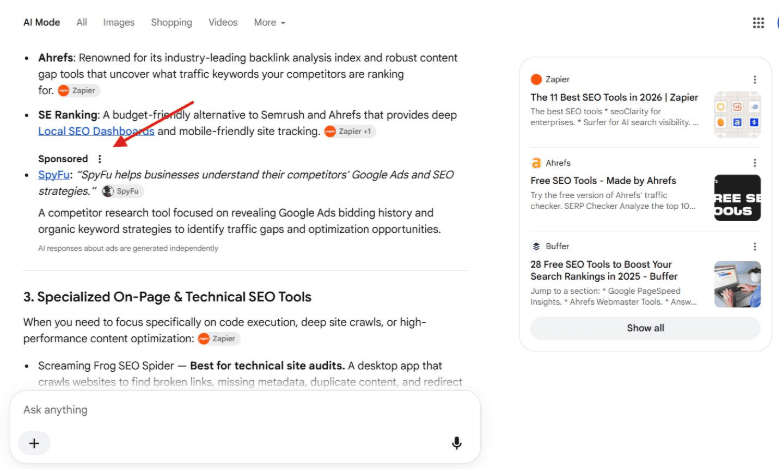
Over at Google, AI Mode is testing ads that look like ordinary text links inside the answer, with a "Sponsored" label on top. There's no word yet on which markets are seeing it.
Sources: OpenAI, Search Engine Roundtable.
Our take: ads are moving from sitting beside the answer to living inside the conversation. ChatGPT ads already run in Australia and we've had clients in the pilot since April, so we'll be watching the new ad formats closely as they head our way. The catch is that an ad can buy you a chat, but it's your organic presence that gets you named in the answer before anyone clicks. Similar to SEO and paid search, paid and organic AI visibility need to be approached under one umbrella.
Google has confirmed a spam update, and this one is a slow burn
Google started rolling out the September 2026 spam update on 24 September. It applies globally and to all languages, and Google says it may take up to two weeks to finish. The year's earlier spam updates wrapped up in under three days, and John Mueller of Google has confirmed this one is likely to run longer. A longer rollout usually means a wider set of changes, though Google hasn't said why this one needs the extra time.
Spam updates target sites breaking Google's spam policies, so most businesses won't feel a thing. Collateral damage does happen, though, and a longer rollout means results can keep shifting for a fortnight before anything settles.
Sources: Google Search Status Dashboard, Search Engine Land.
Our take: hold your horses until the rollout finishes in early October before you judge any movement, and don't start rewriting pages mid-rollout. That said, don't wait for things to fall apart either. There's still time to clean up anything that could harm the site, whether that's a batch of thin pages you pushed out quickly to fill a gap, whether AI wrote them or a person did, or paid links that were never marked as sponsored or nofollow. Clean them up now rather than waiting to see if you got away with it.
_______________________________________________________________
That's edition four done and dusted. Back in a fortnight with more must know SEO & AI Visibility news. Stay tuned!
